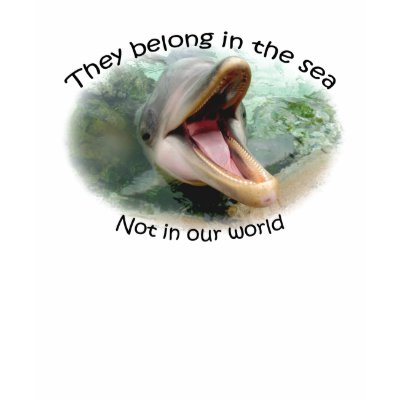
To read an article entitled,
Documentary Exposes Controversial History of Sea World's Role in Captive Dolphin and Whale Industry which is from the Treehugger.com website please click on the highlighted words above.
Source of image:
http://rlv.zcache.com/save_captive_dolphins_tshirt-p235334539980432733uhjv_400.jpgI strongly urge you never to visit a zoo or other type of facility where animals are held captive. Scientific research concludes that holding animals against their wills creates many problems for these animals:
In terms of dolphins these are reasons why dolphins should never be held captive:
"53% of those dolphins who survive the violent capture die within 90 days.
The average life span of a dolphin in the wild is 45 years; yet half of all captured dolphins die within their first two years of captivity. The survivors last an average of only 5 years in captivity.
Every seven years, half of all dolphins in captivity die from capture shock, pneumonia, intestinal disease, ulcers, chlorine poisoning, and other stress-related illnesses. To the captive dolphin industry, these facts are accepted as routine operating expenses.
In many tanks the water is full of chemicals as well as bacteria, causing many health problems in dolphins including blindness.
When a baby dolphin is born in captivity, the news is usually kept secret until the calf shows signs of survival. Although marine mammals do breed in captivity, the birth rate is not nearly as successful as the one in the wild, with high infant mortality rates.
Wild dolphins can swim 40 to 100 miles per day - in pools they go around in circles.
Many marine parks subject their mammals to hunger so they will perform for their food. Jumping through hoops, tailwalking and playing ball are trained behaviors that do not occur in the wild.
Confined animals who abuse themselves (banging their heads against the walls) are creating stimuli which their environment cannot supply. Dolphins in captivity tend to develop stereotypical behaviors (swimming in a repetitive circle pattern, with eyes closed and in silence) because of boredom and confinement. This is equivalent to the swaying and pacing of primates, lions, tigers and bears confined in cages." (source:http://www.inkokomo.com/dolphin/captivity.html )Swimming with captive dolphins is very dangerous for humans and dolphins. To find out why please click on the following link:
http://mundoazul.org/habitats-species/whales-and-dolphins/freedom-for-dolphins/swimming-with-captive-dolphins-is-dangerous/Captivity to any animal is bound to cause trauma to the animal. For instance a new research study relating to captive chimpanzees was recently released at the Science Digest website. In the article, which is entitled, "
Some Captive Chimpanzees Show Signs of Compromised Mental Health, Research Shows", it is stated:
"New research from the University of Kent has shown that serious behavioral abnormalities, some of which could be compared to mental illness in humans, are endemic among captive chimpanzees."To read the entire article cocnerning this research please click on the highlighted words above starting with "Some". Why should other species of life be forced to endure such hardship just because some humans want to make money off of them?